North Dakota's State-Owned Bank, Born of a Socialist Uprising, Wins Over Republicans
The Bank of North Dakota, the nation's only surviving state-owned bank, holds about $11 billion in assets and enjoys support from the state's Republican leaders even as public banking draws interest from the political left.
By News Media House Staff ·
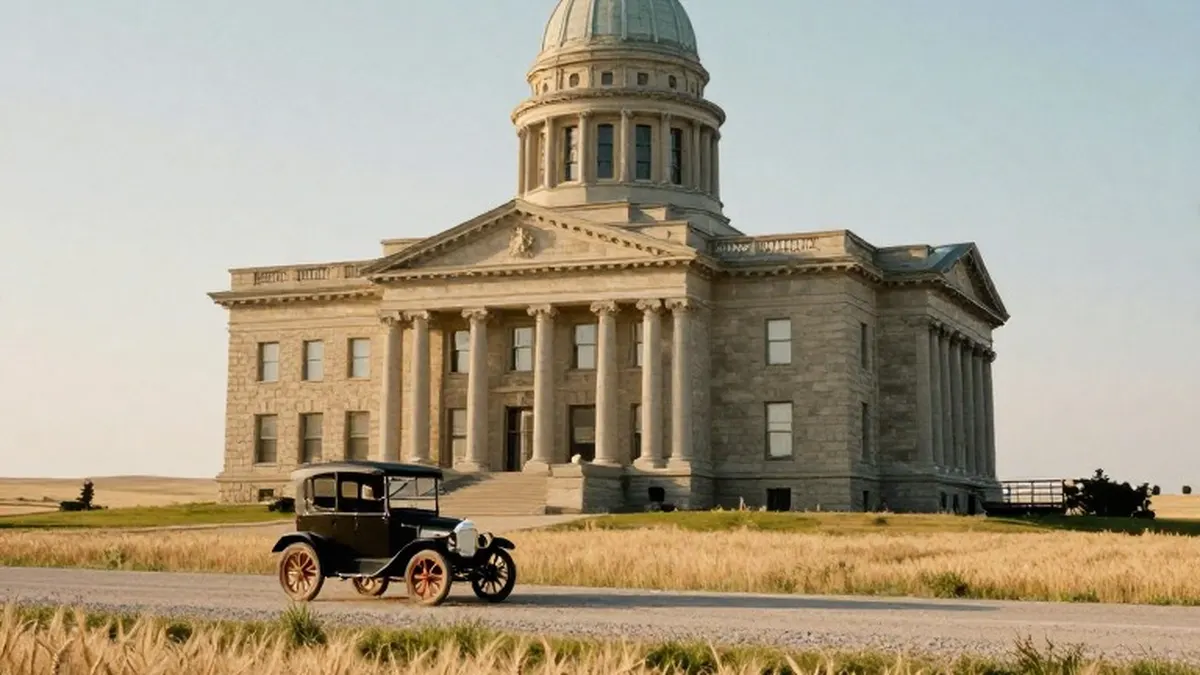
In 1918, a populist wave carried the Nonpartisan League into power in North Dakota, fueled by anger at big banks and industry barons in Minneapolis and Chicago. The group was organized by Arthur C. Townley, a former Socialist Party member and failed flax farmer who toured the state in a borrowed Ford Model T calling for public ownership of banks, mills and factories. By 1919, the legislature had authorized a state-owned and operated bank.
More than a century later, the Bank of North Dakota remains the only surviving state-owned bank in the country. It manages about $11 billion in assets and has outlasted the state's shift from prairie progressivism to deep-red conservatism. Its backers now include Republican Gov. Kelly Armstrong, U.S. Sens. Kevin Cramer and John Hoeven, and Interior Secretary Doug Burgum, a former governor. Hoeven is also a former president of the bank.
"I think it's weird, right? We're one of the most conservative states in the union, and we have this state-run bank that was started by first-generation Norwegian immigrants," Armstrong told CNBC. "I don't think we could set one up now, but I'm sure glad we have it."
The institution functions as a regular bank with a governance structure, state deposits and loans, but it also serves the state's economic goals. Those efforts range from rescuing a struggling coal plant to buying down interest rates on agricultural, energy or housing loans. President and CEO Don Morgan said it can be a powerful tool if used correctly, though it could be dangerous if used wrongly.
Its model has drawn attention from Democrats and democratic socialists ahead of the 2026 midterms. Zohran Mamdani, now New York City's mayor, cosponsored an Assembly bill to let local governments create public banks. Wisconsin candidate Francesca Hong included a Bank of North Dakota-style state bank in her platform, and Reps. Alexandria Ocasio-Cortez and Rashida Tlaib led a congressional bill to make it easier for states to form public banks. Washington state has a work group due to deliver an implementation plan to the legislature by mid-2027, while Massachusetts, New Mexico and California are pursuing their own proposals.
Cramer said North Dakota Republicans are more populist than conservative, which makes the left's interest somewhat natural. Harvard law professor Christine Desan argued that a public bank would let a state join the lending network that gives private banks their advantages. Washington state Sen. Bob Hasegawa said the public should control its own tax dollars rather than letting Wall Street banks leverage them.
The banking industry is not convinced. The American Bankers Association has opposed public bank laws in California and a Los Angeles ballot measure. Spokesman Josh Britton called public banks "a solution in search of a problem" that carry risks for taxpayers. One political risk is that a state bank could favor some industries over others based on officials' politics.
Morgan pointed to the bank's founding rule against competing with local financial institutions, along with its governance framework, as the keys to its survival. The bank is overseen by the Industrial Commission, made up of the governor, attorney general and agriculture commissioner. It acts as a bankers' bank, backing community banks on projects they might be too small to finance. It also offers low-interest student loans, and it provided $500 million in loan support to farmers in 2026 amid tariffs, low commodity prices and high costs.
The bank draws its core deposits, averaging about $6.6 billion, from the state's general fund rather than from individual customers, and profits can flow back to the state budget. Rick Clayburgh, head of the North Dakota Bankers Association, said his group would probably oppose creating such a bank today, but after 107 years it is "a wonderful tool" that lets community banks "punch above their weight class."
The bank's role in the state's energy sector shows how it can work in ways progressives might not choose. Coal Creek Station in McLean County generates 1,151 megawatts for about 1.7 million Minnesota customers and employs about 200 people. In 2020, then-owner Great River Energy planned to retire it by the end of 2022. Burgum, Cramer and Hoeven demanded the company find a buyer, a difficult task as the country moved toward renewable energy.
Originally published by News Media House · Source: CNBC
More News · National news · Report a business · Got a Story?