Pakistan, Saudi Arabia, and Turkiye Meet in Islamabad to Test Mecca Defence Pact
The three nations convene a third time as Houthi strikes on Saudi infrastructure mount, with Islamabad ruling out offensive action in Yemen.
By Rebecca Svoboda ·
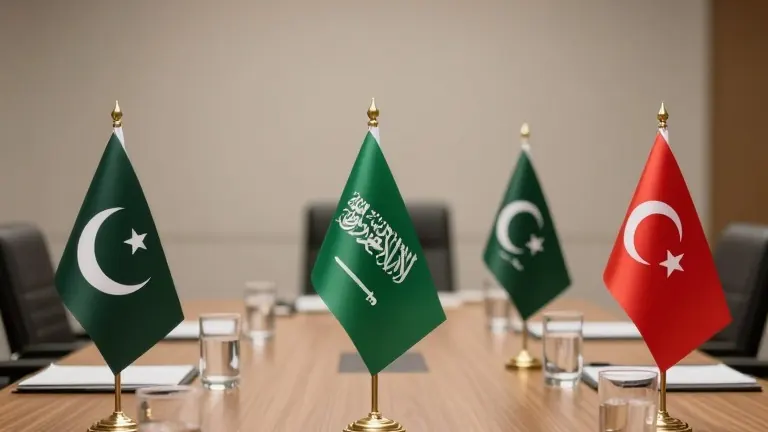
Senior defence and foreign ministers from Pakistan, Saudi Arabia, and Turkiye gathered in Islamabad on Friday for the third session under the Mecca Joint Defence Agreement. The meeting addresses ongoing Houthi attacks on Saudi Arabia and sporadic Iranian strikes against other Gulf states. The pact, signed in August, dictates that an armed attack on one signatory is treated as an attack on all three.
The framework emerged from a conflict that began with US and Israeli strikes on Iran in February 2026. Defence Minister Khawaja Asif confirmed the attendance of the top ministers from each country. He identified the turmoil in Yemen as the primary focus of the current discussions. Asif reiterated that the agreement clearly defines a threat to Saudi Arabia as a threat to Pakistan and Turkiye.
Pakistan has drawn specific lines regarding its military involvement. The country pledged to defend Saudi territory but excluded offensive operations against the Houthis within Yemen. Foreign Ministry spokesperson Sajjad Haider Khan clarified this stance in October. He stated the alliance aims to defend the three nations rather than project power into new theaters of operation.
A large portion of the Pakistani military presence in Saudi Arabia predates the Mecca Pact. In April, Pakistani fighter and support aircraft arrived at King Abdulaziz airbase under a separate 2025 bilateral agreement. This earlier arrangement formed the backbone of current defence coordination. Some experts argue that Pakistan’s current operational limits fall short of Saudi desires for more active support.
Pakistan’s role as both a military ally and a diplomatic mediator creates tension. Umer Karim, an associate fellow at the King Faisal Center for Research and Islamic Studies, explained that deeper military involvement could weaken Pakistan’s standing with Iran. Tehran remains the principal external backer of the Houthi group. Saudi Arabia seeks to keep Pakistan as a conduit for diplomacy with Tehran while also demanding stronger defensive contributions.
Recent Houthi actions have intensified pressure on the alliance. In late November, a strike on a tower in Riyadh’s financial centre injured 11 people. Saudi authorities reported at least 26 deaths from suspected Houthi drone and missile attacks since late September. The majority of those deaths occurred at airports. In October, the member states agreed to ensure the rapid deployment of forces to the kingdom, though the joint statement did not name Yemen.
Turkiye’s Foreign Minister Hakan Fidan stated in November that the current policy focuses on defending Saudi Arabia. No decision has been made on deploying troops inside Yemen. Omer Ozkizilcik, an analyst at the Atlantic Council, expects the alliance to remain defensive for the moment. He noted that Saudi Arabia has primarily requested defensive support, making offensive operations against Houthi militias unlikely in the near future.
The institutional framework is still under construction. Retired Lieutenant General Nauman Mahmood serves as the first secretary-general, appointed in September for a three-year term. The secretariat is based in Riyadh. Pakistan and Saudi Arabia completed ratification in October, while the Turkish parliament approved the agreement in early November. President Recep Tayyip Erdogan signed off on the ratification this week.