Spain Begins Three Days of Mourning After Second Deadly High-Speed Train Crash This Year
A collision between a Renfe train and an Iryo train near Urda has killed 68 people and injured scores more, prompting fresh questions about rail safety in Spain.
By News Media House Staff ·
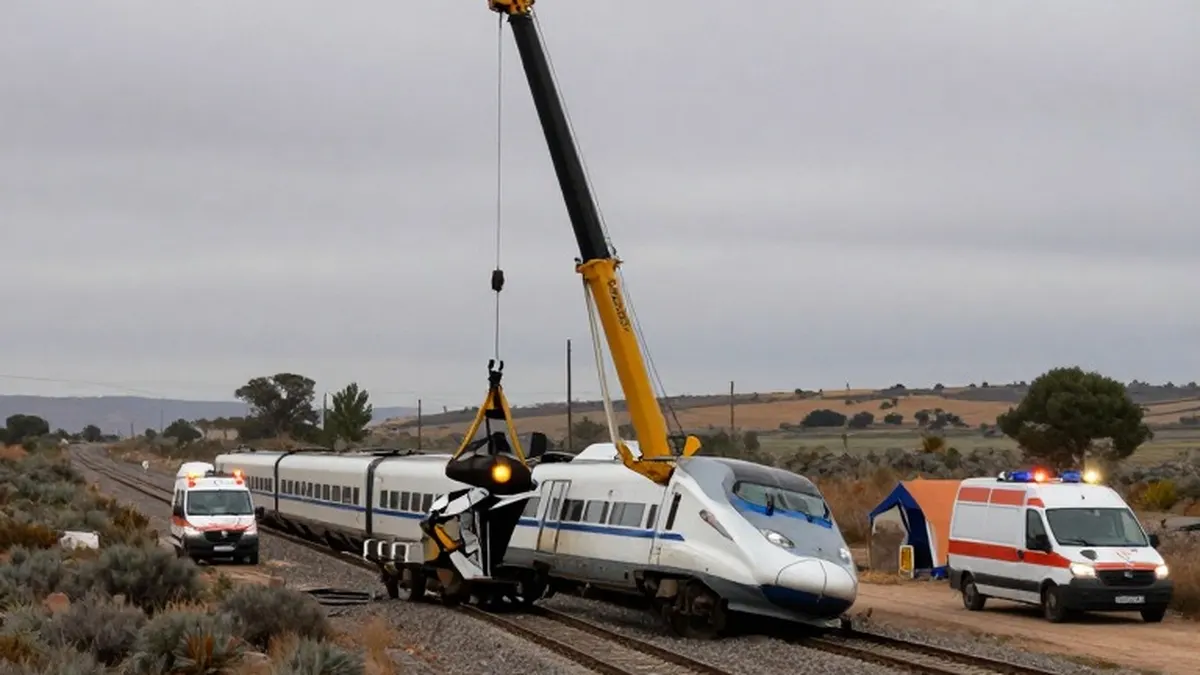
Spain has entered three days of national mourning after a high-speed rail collision killed 68 people and injured scores of others. It is the country's second such disaster this year, and relatives have been anxiously waiting for news of those still unaccounted for.
The two trains, one operated by the state-owned company Renfe and the other by the private firm Iryo, were heading in the same direction on Wednesday morning along the line linking Madrid with the southern region of Andalusia. After the Iryo train stopped, the Renfe train struck it from behind, pushing several carriages off the track near the town of Urda.
Officials said a further 107 people required hospital treatment, 15 of them in serious condition. The transport minister has described an "error" and "inexplicable circumstances" behind the crash, raising new questions about the safety of the national rail network.
Rescue crews searched the wreckage through the night, using cranes to lift twisted sections of metal, according to Agence France-Presse. Emiliano García-Page, who leads the Castilla-La Mancha regional government, warned that the toll could rise because "it has not yet been possible to reach the bottom of the carriages".
To help identify the dead, the Civil Guard has opened four offices in Madrid, Toledo, Córdoba and Seville where relatives can give DNA samples. Blood donation points have also been set up in Castilla-La Mancha and Madrid. In the village of Urda, about 130km (80 miles) south of Madrid, a school is serving as a place where families can ask about their loved ones, with Red Cross teams comforting people as they arrive, some in tears.
Red Cross psychologist Carmen Garcia said "long and hard hours" lay ahead because "every person will manage it in their own way". She described people in shock, others who had not absorbed what happened, and some who were angry, sad or worried. "The grieving will be complicated," she said.
The crash follows a January collision near Adamuz in Andalucía, where 46 people died and dozens were injured when another Renfe train and another Iryo train collided on the same line. Prime Minister Pedro Sánchez called it "unacceptable for a country like Spain to suffer two high-speed train accidents in the same year". He said the cause was being investigated and that any failure in the security system or negligence would be dealt with using the "utmost severity".
Among the first victims named was José Manuel Chacón, a 31-year-old Guardia Civil agent. The force expressed its "deepest condolences" to his family, friends and colleagues. Spanish media reported that the missing included a former minister from the People's party and several foreigners who were thought to be on holiday in Spain.
Alberto Núñez Feijóo, leader of the opposition People's party, demanded an immediate investigation and a "complete and independent review" of the whole rail network. "Spain has the right to know what is going on with its infrastructure," he told reporters.
Originally published by News Media House · Source: The Guardian