Switzerland Narrows Air Defense Choice to Barak MX or SAMP/T NG
The Swiss Federal Council has shortlisted Israel's Barak MX and the European SAMP/T NG for an additional long-range air defense system, while keeping the Patriot purchase going.
By News Media House Staff ·
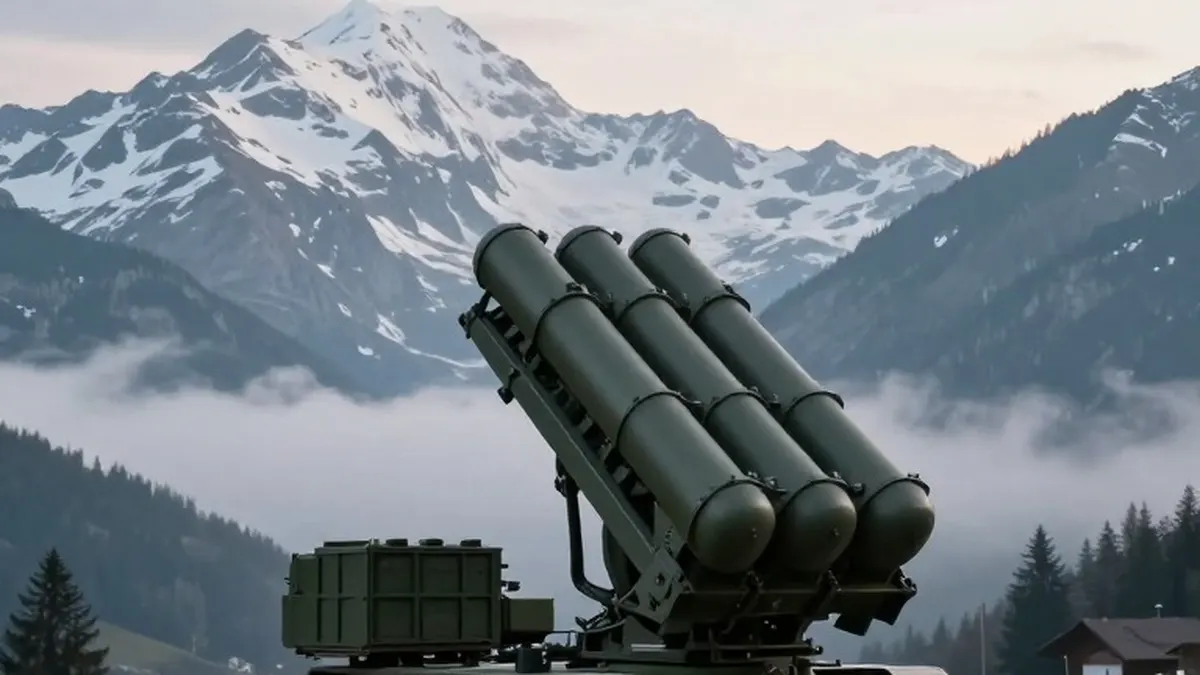
Switzerland has reduced its options for an extra long-range ground-based air defense system to two: Israel's Barak MX and the SAMP/T NG. The country will continue to pursue its Patriot purchase at the same time.
The Swiss Federal Council announced the shortlist on Wednesday, after it reviewed offers from four manufacturers based in France, Israel and South Korea. It said the choice rested on technical, military, defense and security policy considerations.
In its statement, the council said it "recognizes that Switzerland must strengthen its air defenses due to the deteriorating geopolitical situation." It added that this requires ground-based systems with longer range and sufficient ammunition. Combined with shorter- and medium-range systems and fighter jets, such systems can counter long-range attacks, including ballistic missiles.
The Barak MX, built by Israel Aerospace Industries (IAI), has a multi-layered, multi-mission design. Its net-centric configuration lets operators pick the most effective engagement method for the situation, a feature IAI says lowers costs and improves efficiency on the battlefield. The system can fire three missile types from one vertical launcher: the Barak MRAD, with a range of up to 35 kilometers, the Barak LRAD, up to 70 km., and the Barak ER, which can reach targets up to 150 km. Buyers include Morocco, Thailand, Azerbaijan, Slovenia and Cyprus, as well as Israel's navy and India's naval, air and ground forces.
The SAMP/T NG was produced by a joint venture involving Italy, the French company Thales and the European arms consortium MBDA. It is designed to defeat high-altitude threats such as maneuvering tactical ballistic missiles, along with cruise missiles and emerging threats. The mobile system uses next-generation AESA radars, modernized command and control engagement modules and the Aster 30 Block 1 NT interceptor, and can defend both fixed strategic assets and deployed forces.
Europe has turned more and more to Israeli air defense technology over the past decade, particularly after Russia invaded Ukraine and demand grew for rapid, combat-proven systems. European governments have chosen several Israeli systems, among them Arrow 3, Iron Dome, David's Sling and Spyder.
The Patriot remains part of the plan. Militarily neutral Switzerland ordered five Patriot systems from Raytheon and Lockheed Martin in 2022, with delivery originally expected in 2026-2028. Because of the war in Ukraine, the schedule has slipped by at least five to seven years, as Washington intends to give Germany Patriot systems that had been earmarked for Switzerland.
Even so, Bern says it cannot stop the Patriot acquisition without a replacement ready. The council said that "abandoning the Patriot procurement without an alternative system due to the security situation remains out of the question." It stressed the importance of quickly buying an additional system that meets requirements, widens the protected area and reduces reliance on a single supplier or supply chain.
The final choice will follow a debate in the Swiss Parliament on the Federal Council's military financing proposal. That proposal would add 24 billion francs for the armed forces, including six billion francs for an additional long-range ground-based air defense system and a portion for the extra costs of the Patriot systems.
Originally published by News Media House · Source: The Jerusalem Post