El Niño rains trigger historic flower bloom in Chile's Atacama Desert
Heavy precipitation has awakened dormant seeds across the arid region, drawing thousands of visitors and prompting a bid for UNESCO protection.
By Sakura Ellis ·
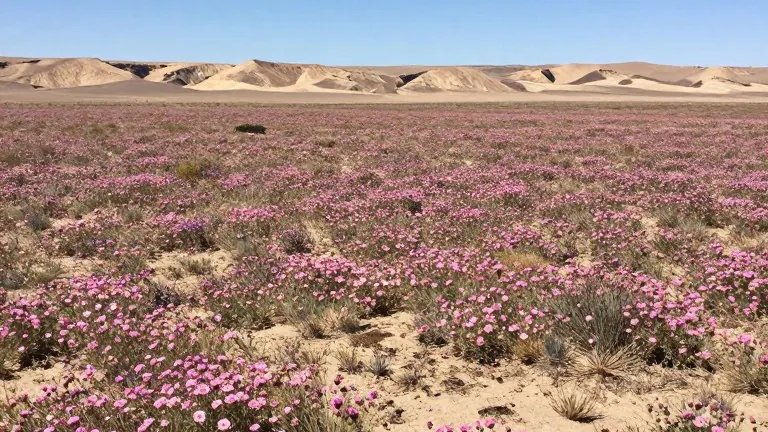
The Atacama Desert in Chile is currently displaying its most extensive floral bloom in three decades, a phenomenon driven by record-breaking rainfall associated with the El Niño weather pattern. The event has transformed the arid landscape into a vivid expanse of pink, yellow, lilac, and purple vegetation stretching across the desert floor.
Heavy rains arrived in July and August, bringing some areas the heaviest precipitation recorded since the 1950s. While the weather caused flash floods that damaged dozens of homes and forced hundreds of residents to evacuate, the moisture penetrated deep into the parched soil. This allowed millions of dormant seeds, bulbs, and tubers to sprout, many of which had remained underground for decades.
More than 200 plant species are currently in flower. The bloom began with a pale-yellow haze a month ago, followed by a soft purple hue as other bulbs germinated. Now, nearly every crevice in the desert is covered in color. Scientists report finding flowers in locations where they had never been previously recorded, indicating that some bulbs have slept in these spots since before detailed study of the phenomenon began in 1997.
Moisés Grimberg, administrator of Llanos de Challe National Park, described the event as a natural seed bank coming to life. He noted that the biological window for these species to complete their life cycle is short, lasting roughly two to three months. The park, which spans 113,000 acres along the arid coastline, normally attracts about 10,000 visitors per year. Recent weeks have seen 15,000 tourists arrive, with Chile's national tourism board projecting 300,000 overnight trips during the two-month bloom period.
The bloom supports a transient ecosystem, allowing insects to hatch and attracting lizards, bats, and larger mammals such as guanacos. Among the notable species is the garra de león, a crimson flower with green, flame-like leaves that grows only on this specific stretch of coastline. Biologists from INIA, Chile's national seed bank, are collecting specimens to analyze genetic material and document unique adaptations for surviving extreme aridity.
Ana Sandoval, a biologist involved in the collection, stated that the desert is awakening from its dormant state. She emphasized that the region is not devoid of life but is waiting for specific precipitation conditions to trigger growth. Her team is examining various plant features, including leaves with fine hairs and thick waxy cuticles, that help harvest water in the dry environment.
Local authorities are moving to formalize the protection of this ecosystem. A national park dedicated to the bloom was established in June 2023, covering a 141,000-acre area. Miguel Vargas, governor of the Atacama region, has begun the process of seeking UNESCO World Heritage recognition. Vargas said the designation would diversify the regional economy, which is currently heavily reliant on mining, and place the Atacama region on the world stage.
The bloom is projected to last until mid-November. As the flowers fade, scientists will continue to analyze the collected seeds to determine if this was the largest flowering event on record and to identify any previously unknown species among the millions of plants.