US Deploys New Task Force to Blockade Iran's Land and Sea Trade Routes
Washington established Task Force Iron Gate to restrict goods movement, a move Tehran's military called wordplay while two tankers reported fires in the Strait of Hormuz.
By Rebecca Svoboda ·
The United States launched a new military initiative on Saturday to tighten its grip on Iran's economic lifelines, targeting land borders and the Caspian Sea in addition to existing naval blockades. The move escalates tensions in the region, where shipping disputes and trade restrictions are already straining global supply chains.
US Central Command (Centcom) announced the creation of Task Force Iron Gate, a unit based in Florida. The task force will coordinate with other US government agencies to control the flow of advanced weapons, dual-use technology, and sanctioned materials through Iran's seven land borders and its coastline on the Caspian Sea. Centcom stated the unit was established on the orders of Admiral Brad Cooper, who commands the region.
Cooper said the initiative builds on the current US naval blockade of Iranian ports. He noted that the blockade has already prevented Iran from exporting more than $25 billion in crude oil in recent months. Cooper claimed the new collaboration would further constrain Iran's ability to finance terrorism, rebuild weapons factories, and replenish its military inventory.
Iran's Islamic Revolutionary Guard Corps (IRGC) quickly dismissed the new unit. Hossein Mohebbi, the IRGC spokesman, told the semi-official Fars news agency on Sunday that the Iron Gate plan is merely wordplay. He argued that the Americans cannot achieve their objective of causing an economic collapse through this approach. Mohebbi pointed out that Washington had previously predicted Iran would suffer economic collapse within two weeks, a timeline that had already passed without the predicted result.
Mohebbi added that Tehran had prepared for economic pressure and maintained close relations with its neighboring countries. Those neighbors include Iraq, Turkey, Armenia, Azerbaijan, Pakistan, Afghanistan, and Turkmenistan. The Caspian Sea coastline also provides a trade route to countries such as Russia.
The announcement drew criticism from former US officials. Joe Kent, the former director of the US National Counterterrorism Center, accused Centcom of undermining diplomatic efforts. Kent, who resigned over the US-Israeli war on Iran, called the initiative a brash provocation. He noted that Vice President JD Vance was attempting to negotiate with Tehran at the same time. Kent wrote on X that the military was pursuing policy by CONOP, a tactic where commanders subvert the White House without directly disobeying the president by taking actions that ensure war escalates or perpetuates.
Kent warned that enforcing further restrictions puts US troops at risk and could trigger renewed fighting. He stated that the blockade keeps troops in harm's way and risks a shoot-down that would launch the US back into kinetic war. Kent also called on President Trump to appoint a new national security team capable of ending the conflict rather than prolonging it.
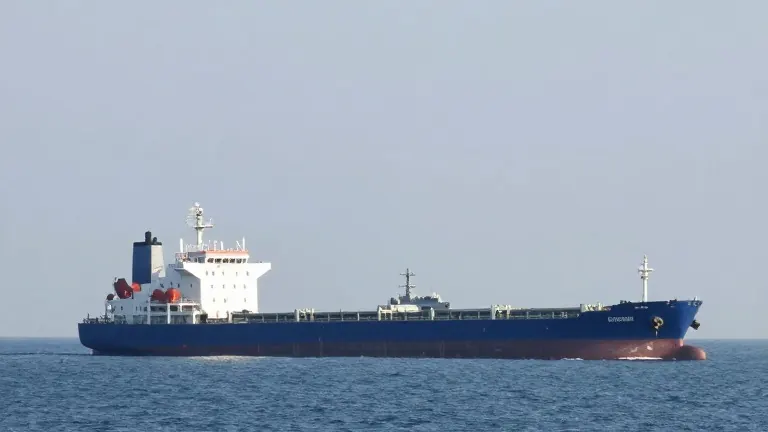
Shipping incidents accompanied the political dispute. The IRGC Navy said two oil tankers caught fire after striking naval mines in and near the Strait of Hormuz late Saturday. The force claimed the vessels had switched off their navigation and positioning systems and used unauthorised routes. One tanker was hit east of the strait, while the other was hit inside it. Iranian media carried the claims, though the identities of the vessels and the cause of the fires could not be independently verified.
These reports followed a Centcom statement on Saturday regarding a US aircraft that disabled a cargo ship in the Gulf of Oman. The US military identified the vessel as the St Kitts-flagged Huda and said it had visited an Iranian port. The ship had repeatedly attempted to breach the US naval blockade.
In a related incident, the UAE National Guard said its Coast Guard rescued 22 people on Sunday after a fire broke out aboard a cargo ship in the Sea of Oman. The rescued crew members were Arab nationals who received first aid before being handed over to authorities. The National Guard reported that all 22 individuals were in stable condition.
More Business · Consumer Watch · Report a business · Got a Story?