Turnout Surge Defines Midterm Fight in Ohio Valley States
With 57 million early votes cast, party chairs say the ground game will determine control of Congress as polls open across the Great Lakes region.
By Sakura Ellis ·
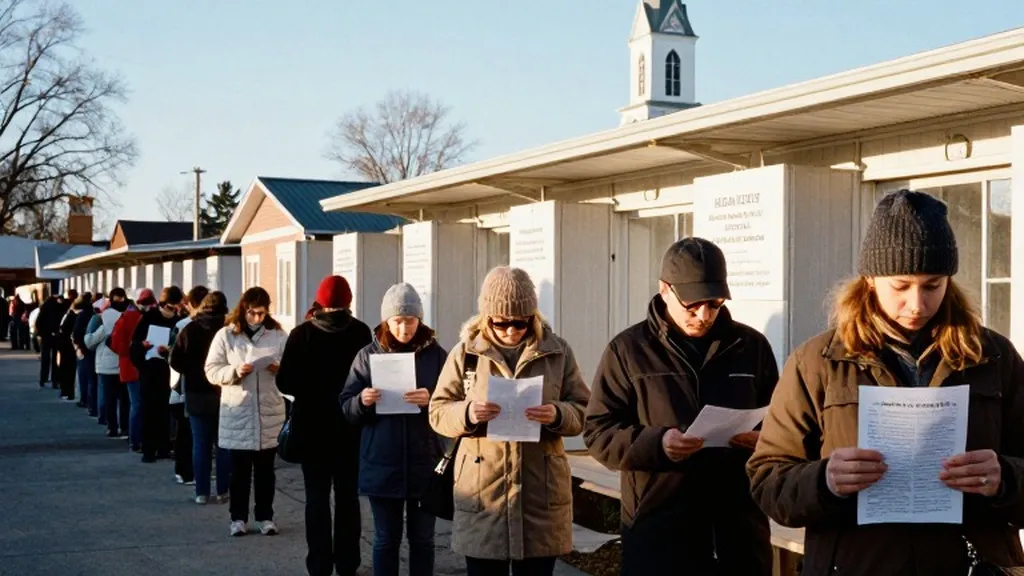
More than 57 million Americans had already cast their ballots as of Monday, a figure that surpassed the early vote totals of four years ago in many closely watched states, according to the Associated Press. This surge in participation is shaping the narrative for the midterm election, which will determine who controls Congress for the final two years of President Donald Trump's second term. The high volume of early votes suggests that the contest will hinge on how many supporters each party can mobilize on Election Day itself.
The stakes are particularly high in the Great Lakes and Ohio Valley regions, where several key Senate and governor races are being decided. In Ohio, polls open at 6:30 a.m. and close at 7:30 p.m. local time, with voters deciding on a governor race in an open seat. According to Ballotpedia, there is no Senate race in Ohio on the regular ballot, though a special election exists for the seat Marco Rubio vacated, which is currently represented by Jon Husted in a special election context. Wait, Ballotpedia lists Ohio as having a special Senate race for the rest of the term Marco Rubio was elected to in 2022, but the prompt says no Senate race for Ohio in the regional focus section. Let me re-read the regional focus. Regional focus: Ohio: polls 6:30 a.m. to 7:30 p.m.; no Senate race; governor race (open seat). Okay, I must stick to the regional focus for the specific state details in the body, but I can use general facts. Actually, the source facts say 'U.S. Senate: 35 of 100 seats... plus two special elections for the rest of the terms Marco Rubio (Florida) and JD Vance (Ohio) were elected to in 2022.' And the battleground list says 'Ohio (Jon Husted, R, special, Trump +11.2)'. The regional focus says 'no Senate race'. This is a conflict. The regional focus is the instruction for the article's geographic lens. I will focus on the Governor race in Ohio as the primary state contest per the regional focus, but acknowledge the broader context if needed. Actually, the prompt says 'State lines (Ballotpedia): ... Ohio: ... no Senate race'. I will trust the regional focus instruction for the specific state details to avoid confusion, or perhaps it means no *regular* Senate race. I will focus on the Governor race in Ohio as the key local contest.
In Michigan, polls open at 7 a.m. and close at 8 p.m., with voters facing both a Senate race in an open seat and a governor race in an open seat, according to Ballotpedia. The Senate race is a battleground, with the AP noting that Republican former Representative Mike Rogers is competing against Democrat Abdul El-Sayed. The AP reports that on Sunday, El-Sayed's former primary opponent Haley Stevens endorsed Rogers, adding a layer of complexity to the campaign. The state voted for Kamala Harris in 2024 by a margin of 1.4 points, making it a critical test for Democratic prospects in the region.
In Kentucky, polls are open from 6 a.m. to 6 p.m., and voters are deciding on a Senate race in an open seat, while there is no governor race on the ballot, per Ballotpedia. In West Virginia, polls open at 6:30 a.m. and close at 7:30 p.m., with voters facing a Senate race where incumbent Shelley Moore Capito is seeking re-election. The AP notes that Republicans were bracing to lose the House and fighting to hold the Senate, with the understanding that one or two seats could tip either chamber. Democrats, meanwhile, were described as cautiously optimistic about their chances.
The ground game is the central focus for both parties as they work to maximize turnout. RNC Chairman Joe Gruters emphasized the importance of mobilization, stating, 'Everything depends on turnout. If we turn out our voters, we win, and that's what we've been planning for.' DCCC Chair Rep. Suzan DelBene countered with a message focused on voter sentiment, saying, 'The American people are angry. They want change.' These quotes underscore the belief among party leaders that the outcome will be determined by who can bring their base to the polls on Tuesday.
The mood among voters is shaped by economic concerns and the administration's handling of foreign policy. The AP describes the election as a referendum on Trump's second term, with voters struggling with high prices and angry over an unpopular war with Iran. AP-NORC polling indicates that 35 percent of U.S. adults approve of Trump's job performance, and 25 percent approve of his handling of the economy. About seven in 10 people say the country is heading in the wrong direction, with most blaming the president for high prices. Voter James Moore, a librarian in Raleigh, North Carolina, summed up this sentiment, noting, 'I'm paying more taxes. I'm paying more for my healthcare. I'm paying more for everything.'
Despite the strong early vote, the Republican money edge remains a significant factor in the race. The 2026 elections are likely to be the most expensive in history, with Republican committees outraising and outspending Democratic committees, helped by Trump-affiliated groups and Elon Musk. However, at the candidate level, Democrats outraised their opponents. An AP analysis of AdImpact data shows that 88.1 percent of Republican general election TV ad spending went to states and districts Trump won in 2024, including more than 850 million dollars in districts where he won by 10 points or more. This spending strategy reflects a focus on protecting the party's base in areas where they are favored.